
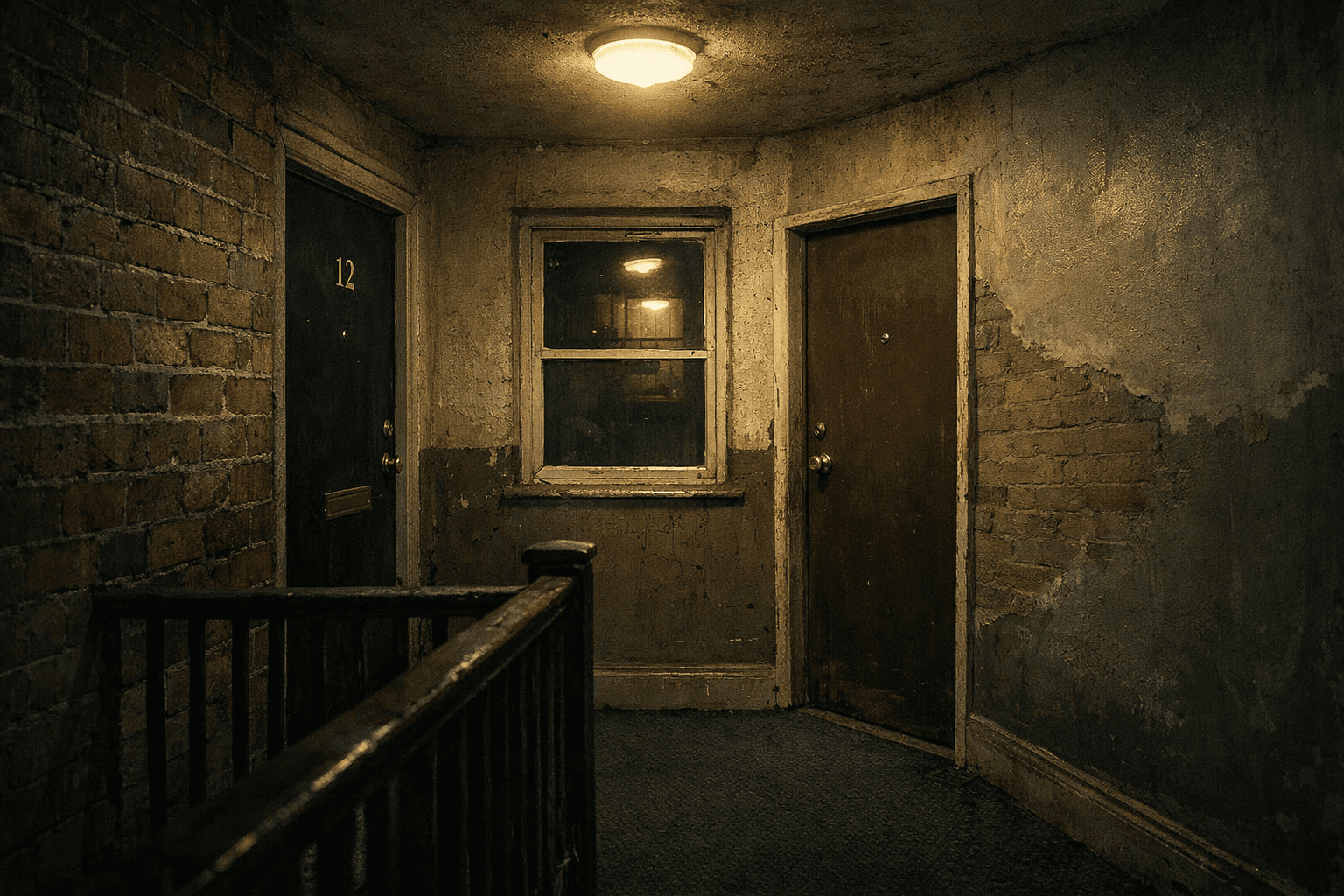
This apartment horror story begins with a cheap top-floor flat, a quiet street in Leeds, and one detail that should have made no sense from the start. The stairwell ended outside my door, but every night I could hear someone walking around in the apartment above mine.
I moved into the building in late October, after a breakup and a rushed job change put me in a city where I didn’t know anyone well enough to stay on their sofa. The place was in Leeds, about a ten-minute walk from the station, on a narrow street with old brick buildings that had been turned into flats one bad decision at a time. It used to be a boarding house, then offices, then flats. You could tell none of those conversions had been done with much love.
The letting agent, Claire, sold it to me as “small but quiet.” She said that with the kind of smile people use when they’re hoping you won’t ask follow-up questions. The building had six current flats, two on each level. Mine was at the top, Flat 6, on the right side of the last landing. Flat 5 was opposite me. The staircase stopped there. No extra landing. No attic access. No ladder hatch. Just my door, Flat 5’s door, and a little window at the end of the hall that looked over the alley behind the building.
But from the street, there were clearly two dormer windows above the top-floor windows.
I noticed that during the viewing and asked about it. Claire said it was just sealed roof space left over from the old layout. “Not usable,” she told me. “They never converted it properly.”
That sounded lazy, but not impossible. Old buildings end up with awkward empty spaces all the time. I was tired, broke, and trying to convince myself I had finally caught a lucky break. The rent was lower than anything else I had seen within walking distance of work. The boiler worked. The windows shut. The front door locked without having to shoulder it. At that point, my standards were not high.
The first night was fine apart from the usual sounds of living in a cheap building. Pipes ticking. A neighbour’s television murmuring through a wall. Somebody coming in late and trying, not very well, to be quiet on the stairs.
The second night, at a little after midnight, I heard footsteps directly above my bed.
Not the roof settling. Not water in the pipes. Footsteps. Slow, measured, heel to toe, crossing from one side of the room to the other.
I lay still and listened.
There was a pause, then a scrape. Wooden chair legs dragged across a floorboard. Then three more steps.
I remember staring at the ceiling in the dark, trying to make my brain choose one version of reality and stick to it. Either there was a person above me, which made no sense, or there wasn’t, which somehow made less sense because I was definitely hearing one.
The next morning I asked Claire about it. She replied thirty minutes later with a message so casual it almost annoyed me more than if she’d ignored me.
Old roof. Wind. Sound travels strangely in that building.
That night there was no wind at all, and the footsteps came back.
This time they were in the front room, above my sofa. I switched the television off and sat there listening to them move from one end of the ceiling to the other. I even took out my phone and recorded it, but cheap phone microphones flatten everything. When I played it back, it just sounded like weak thumps in an empty box.
I lasted another two nights before I started asking neighbours.
Flat 5 belonged to a woman called Ellie. She was in her early thirties, worked long shifts at St James’s, and always looked like she was either just coming home or just leaving again. I caught her on the landing as she was locking up one morning.
I tried to make it sound normal.
“Have you ever heard anything above us?”
She stopped with her keys still in the lock.
“Above us?”
“Yeah. Above my flat. Footsteps. Furniture moving.”
She looked at me for maybe two seconds too long.
“I hear you sometimes,” she said.
“Me?”
“You pacing around.”
“I’m asking about above me.”
That made her glance up, just for a second, toward the ceiling over our landing. It was a small movement, but enough to tell me she had done that before.
Then she said, “This building carries sound weirdly.”
Same phrasing. Not exactly, but close enough to Claire’s reply that it hit me wrong.
“Did the last tenant mention it?” I asked.
Ellie let out a breath through her nose like I had accidentally stepped on something sore.
“The last tenant in your flat didn’t stay long.”
“How long?”
“I don’t know. Two weeks? Maybe less.”
“Because of the noise?”
She gave me a look that said she regretted answering the door of this conversation at all.
“Just don’t start banging on the ceiling,” she said. “He did that. Made it worse.”
Then she went downstairs without another word.
That should have been enough for me to start looking for somewhere else. I know that. But moving costs money. Breaking a tenancy costs money. Hotels cost money. The logic you use when you’re scared and broke is not good logic. It is just the cheapest one available.
So I stayed.
A few nights later I came home after a late shift, took my shoes off by the door, microwaved leftovers, and sat at the little table in my kitchen eating in silence. I dropped my fork. It hit the tile, bounced once, and spun under the radiator.
About five seconds later, directly above me, I heard a fork hit tile and spin.
I froze with my hand still on the table.
Then, above me, a chair moved back.
I stood up slowly.
Another chair moved above me.
I took one step toward the middle of the kitchen.
One step answered from the ceiling.
I didn’t think. I grabbed the broom from beside the fridge and smacked the ceiling with the handle.
The response came after a pause.
Three slow knocks.
Not loud. Not angry. Almost patient.
I backed into the hall and stayed there long enough for my leftovers to go cold. At some point the footsteps resumed. They crossed the room above my kitchen, turned, crossed back, then stopped over what would have been the doorway.
I slept with every light on.
The next day, in the harsh calm of daylight, I tried to rebuild my dignity by looking for a sensible explanation. I checked the building from outside. Six windows for the main flats, then the two dormers above, set into the roof slope. Both dusty. One with a torn old blind hanging at an angle inside.
There was no external staircase. No fire escape to the upper windows. No side entrance. Nothing clever hidden around the back. Just old brick, drainpipes, and the alley bins.
At work I spent half my lunch break searching the council planning portal. I didn’t even know exactly what I was looking for at first. I typed the address, dug through old applications, and found records going back years.
One file, from the early two thousands, was for the conversion into six flats.
The attached drawings showed something that made the back of my neck go cold.
Before the conversion, the building had seven units.
Flat 7 sat above the top floor, in the roof space, running the width of the front of the building. There had once been a narrow timber staircase from the top landing up into it. The conversion notes mentioned that access had been removed for fire compliance and that Flat 7 would be “decommissioned and sealed.”
Decommissioned.
Not demolished. Not removed. Sealed.
I read that word three times.
That evening I took a torch and examined every inch of the top landing. There, under the freshish paint and cheap plaster, I found it. A rectangular section of wall beside my door, slightly uneven, about the right width for an old stair opening that had been closed over. If you weren’t looking for it, you would never notice. Once you did, it became impossible not to see.
There had been stairs above mine once.
Now there weren’t.
That should have made me feel better. At least it meant the space above me was real. But it didn’t make me feel better, because real roof space does not copy the sound of a dropped fork.
Things got worse after I found the plans.
Maybe because I started listening for it. Maybe because whatever was up there realised I had started paying attention.
I would set my phone on the coffee table, and a few seconds later I would hear something being placed above me in the same spot. I would open the bathroom tap, and the pipes over my head would shudder as if another sink had turned on above mine. One night I sneezed in the hall and heard a sneeze from directly overhead that sounded almost, but not quite, like mine.
It was like living under a delayed reflection.
I began staying later at work just to avoid coming home. When I did come back, I kept the television on for company. I called my mum more often than usual, but I never told her the real reason. You can tell people your boiler is acting up. You can tell people your neighbour is loud. You cannot tell your mother, with a straight voice, that the flat above you does not have stairs and might be rehearsing being you.
About two weeks in, I found a note on the mat inside my front door.
Please stop walking around after midnight.
That was all it said.
No name. No flat number.
I stood there reading it until my face got hot.
I worked early shifts that week. I was usually asleep before midnight. And even if I wasn’t, I didn’t walk around much because I had already become stupidly aware of every sound my floorboards made.
I knocked on Ellie’s door with the note in my hand.
She opened it wearing one sock and a look of deep regret.
“Did you put this through my door?”
She read it once and shook her head.
“No.”
“Did anyone ask you to?”
“No.”
“Who else has a key to the building?”
She looked down the hall before answering, as if the stairwell itself might be listening.
“Landlord. Claire. Cleaners, maybe. Why?”
“Because somebody’s messing with me.”
She gave the note back carefully, by the corner.
“Move out,” she said.
That was the first time anyone had said it plainly.
“Why don’t you?” I asked before I could stop myself.
She didn’t answer right away.
Then she said, “Because it’s only above your flat now.”
I must have looked like I hadn’t heard her, because she added, “When I moved in, it was above mine. Then the guy downstairs moved out and it stopped. After you came, it moved up.”
I said nothing.
She stepped back and lowered her voice.
“The tenant before you used to shout at it. He said it waited until he did something, then did it after. Like it was learning timing. He told Claire somebody was living in Flat 7. She laughed at him. Three days later he was gone.”
“Did you ever see anyone?”
“Not clearly.”
“What does that mean?”
“It means one night I got home after a late shift and saw someone standing in the top dormer window looking down into the street. When I went upstairs, your flat was empty.”
That landed so hard in my stomach I had to grip the doorframe.
“Why didn’t you tell me this before?”
She gave me a tired, almost angry smile.
“Would you have believed me?”
No. I wouldn’t have.
That same night, I stood across the road from the building for nearly an hour, pretending to smoke a cigarette I had no intention of finishing, just staring up at the dormers.
Nothing moved.
The blind in the left dormer hung crooked and still. The streetlight painted both windows the same flat orange-grey.
I started to feel embarrassed. Then, just as I was about to go back inside, a light came on behind the right dormer.
Not a bright light. More like a lamp in another room, enough to give shape to the space behind the glass.
And there, in the window, was a figure.
It stood exactly where I was standing, one floor up.
It was not looking out at the street in general.
It was looking at me.
I stepped sideways.
A moment later, it stepped sideways too.
Not at the same time. After me.
Delayed.
I don’t remember going back into the building. I remember fumbling my keys, nearly dropping them, then slamming my door and locking it with both hands shaking so badly I had to redo it twice.
The footsteps above me began within minutes.
Back and forth. Back and forth. Faster than usual.
At some point, maybe around one in the morning, I heard something I had not heard before.
My own voice.
It was faint, like it had come through two walls and a floor, but it was mine. I could not make out the words. Just the sound of my voice in the shape of a sentence.
I threw some clothes into a bag, grabbed my laptop and charger, and left for a budget hotel near the station.
I stayed there two nights. On the second day Claire finally called me back.
She sounded irritated before I had even said hello.
“There is no flat above yours.”
“I found the planning records.”
“That space is sealed.”
“Then who’s been in the window?”
Silence.
Then, in a completely different tone, she asked, “Have you been trying to access the roof?”
“No.”
“Don’t do that. It’s dangerous and you’ll be liable if there’s damage.”
I actually laughed.
“I’m telling you someone is in a sealed flat and you’re worried about roof damage?”
“There is no habitable flat above you,” she said, crisp now, like she was reading from a line she had used before. “If you are unhappy in the property, you can submit notice as per your tenancy.”
Then she hung up.
I went back because most of my stuff was still there, because hotel bills add up, and because some part of me still wanted proof. Not just fear. Proof.
The chance came from sheer luck.
Three mornings later I saw a roofer’s ladder in the alley behind the building. They were working two doors down, replacing broken slates after heavy rain. The ladder was resting against the rear wall during their tea break, tall enough to reach the lower roof section that ran behind our building.
I stared at it from my kitchen window for a full minute.
Then I put my shoes on.
I know how stupid this was. I knew then. But fear does strange things to your sense of what counts as a bad idea. When you’ve been living with something impossible long enough, climbing onto a wet roof starts to feel almost reasonable.
I went out the back, checked the alley was empty, and climbed.
The lower roof was narrow but walkable if you stayed close to the wall. From there I could edge along to the side slope and up toward the dormers at the front. My heart was hammering so hard I could feel it in my throat. The slates were slick. The city sounded distant, flattened by wind and height.
When I reached the right dormer, the one where I had seen the figure, I found the window shut but not latched.
I pushed it open.
Warm air came out.
Not warm like trapped roof heat. Warm like a room somebody had been sitting in.
I climbed through.
Flat 7 existed.
That is the simplest way I can say it.
It was not unfinished roof space. It was not open rafters and insulation. It was an actual apartment.
Same basic layout as mine. Front room at the front, kitchen behind it, bedroom to one side, bathroom tucked into the back. Lower ceiling. Older fittings. Water stains. Rotten skirting boards. Wallpaper hanging in strips. But a real flat.
And it had no stairs.
Where the old access should have been was a section of hallway floor covered in mismatched boards and old rug, as if somebody had built over the opening years ago from the inside. The front door still stood in place, but when I opened it, there was nothing beyond it except a brick wall a few inches away. The entire doorway had been blocked from the other side.
Whoever had been up there had only one easy way in and out now.
The window.
The room smelled like damp plaster, dust, and something else underneath. Not rot. Not animal. A warm, sour smell I recognised only because it was the smell my own flat had after I’d been working from home all day with the windows closed. Human air. Lived-in air.
My skin went cold.
There was furniture in the front room. A table. A chair. A standing lamp without a shade. All old, all damaged.
The chair was positioned exactly where mine was downstairs.
On the table sat a chipped white mug.
Mine downstairs had a chip on the rim in the same place.
I told myself that meant nothing. Cheap mug. Common shape. Coincidence.
Then I saw the notebook.
It was open on the table under the lamp. The pages were filled with handwriting that started as shaky lines and slowly turned into words. Some pages were just my first name written over and over. Some were phrases.
Can you hear me
Stop copying me
Who’s up there
please stop walking around after midnight
That last line had been pressed so hard into the page it had torn through.
I didn’t realise I was backing away until my leg hit the chair behind me.
In the bedroom I found more of my things.
A single black sock that I had lost the week before.
The blue pen from beside my bed.
A receipt from the supermarket, folded twice.
My old work pass from a job I’d quit months ago, something I kept in the back of a drawer and had not thought about since moving in.
All arranged neatly on the floor beside the mattress like collected samples.
Then I heard movement below me.
Not footsteps above, where I had heard them for weeks.
Below.
From my flat.
A chair scraped across the floor.
My chair.
Then, clear as if I had left a speaker on, my own voice laughed once from directly under my feet.
It was not a normal laugh. It was a copy of one. The shape right, the feeling wrong.
I ran to the dormer window, nearly slipping on the warped boards, and looked down into the street. My front room window was lit. I had not left the lights on.
A shape crossed behind the blind.
Same height as me. Same outline.
I don’t mind admitting this part. I panicked. Completely.
I left the notebook. Left the window open. Nearly fell getting back onto the roof. I got down the ladder too fast, burned my palms, and didn’t stop until I was halfway down the street with my keys digging into my fist.
I called the police from outside a corner shop because I didn’t trust myself to speak if I stood anywhere darker.
Two officers came. I told them somebody had got into my flat through a sealed upper apartment. I did not say that the upper apartment was learning my voice. I kept it as plain as I could. Squatter. Illegal access. Hidden space.
They went in with me.
My flat was empty.
The lights were on. The chair in the front room had been moved three feet from the table. The mug in my kitchen sink was wet even though I had not used it that day. In the bathroom, the mirror had been wiped clean with a single hand across the centre, like someone had wanted to look at their face through the steam.
The officers checked the landing, then the roof access question turned into a whole separate mess because there wasn’t one. No hatch. No visible opening. Nothing they could use without calling someone else out.
One of them asked if I had been drinking. The other asked whether I had anyone who could stay with me for a few days.
I said no to both.
I never spent another night there.
I went back once, during daylight, with two friends from work and a van. We cleared the flat in under forty minutes. I wanted to look up at the dormer while we loaded boxes, but I couldn’t make myself do it for long. The blind had shifted. It hung straighter now.
When I returned my keys, Claire refused to discuss the upper flat. She said if I kept making accusations, the landlord would consider action for slander. That almost made me laugh again. Not because it was funny. Because there are people who will look at a rotting apartment with no stairs, sitting warm and occupied above a paying tenant, and still decide the real problem is paperwork.
Ellie moved out a month later. She found me through a mutual contact and sent one message.
It’s above 6 again.
That was all.
I asked what she meant, but she never replied.
This happened eight months ago. I live somewhere else now, in a bland newer building with clean walls and loud plumbing and absolutely no charm. I overpay for it and I do not care. I have neighbours on both sides and one below. Nobody above. That part is non-negotiable.
I still wake up sometimes expecting footsteps over my head.
A week ago, I got an email from an address I didn’t know. No subject line. No greeting.
It said, “Hi. This might sound strange, but did you used to live in Flat 6 on Mercer House? I found your old supermarket receipt under a loose board. Also, can I ask you something? Is there meant to be a flat above mine?”
I have not replied.
If you ever rent an old top-floor place because the price looks too good and the agent tells you the roof space above is sealed, do yourself a favour before you sign anything.
Stand across the road and count the windows.
Then go inside and count the stairs.
If those numbers do not match, leave.